
What is special about “special applications” conversion groups?
Special Applications – Fundamentals
ASTM D1250 supports calculations of volume correction factors and base densities for four different product types (1, 2,3 and 4, linked to the API product groups A, B, C and D):
1 : Crude Oil – A
2 : Products – B
3 : Special Applications – C
4 : Lubricants – D
Special Applications may be utilized for products which are not covered by any of the other three product types, either due to their technical limitations or since better product specific data is available to describe the temperature dependency of the product – e.g. for denatured ethanol as described in API MPMS Chapter 11.3 .
For Special Applications (product type 3), in contrast to product types 1, 2 or 4, the product specific density at base conditions (“Fix. density”) must be defined in the SAP Material Master for SAP QCI conversion groups.
Also, the product specific thermal expansion coefficient (“Conv. coeff.”) must be defined in the SAP Material Master as well:
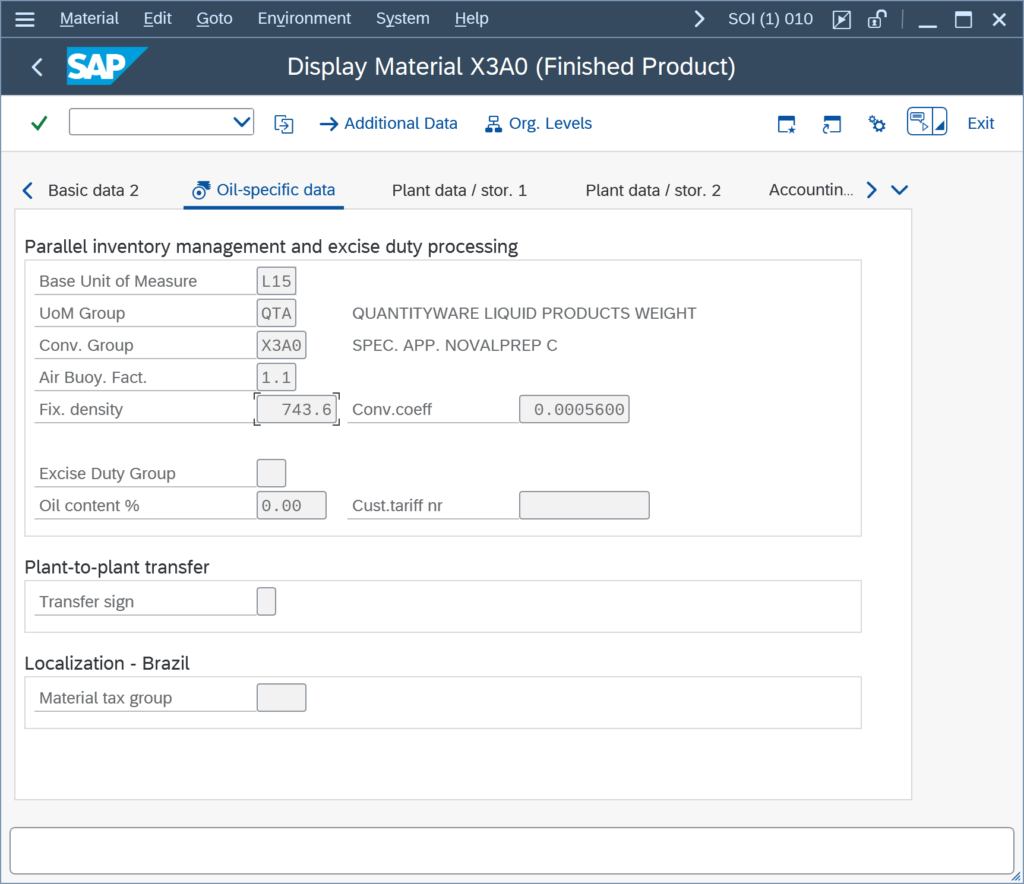
Historically, these two values are defined in the SAP Material Master as product specific fixed values without UoM (which may be considered a design risk).
For such SAP QCI conversion groups it is assumed, that absolute density values are given in kg/m³ and the thermal expansion coefficient in 1/°C or 1/°F (depending on the ASTM D1250 version and base temperature).
Thus, in order to provide a choice for customers, QuantityWare MQCI conversion groups are also provided within the client 045 template for Special Applications – in addition to the QuantityWare SAP QCI template conversion groups for legacy SAP QCI Special Application calculations.
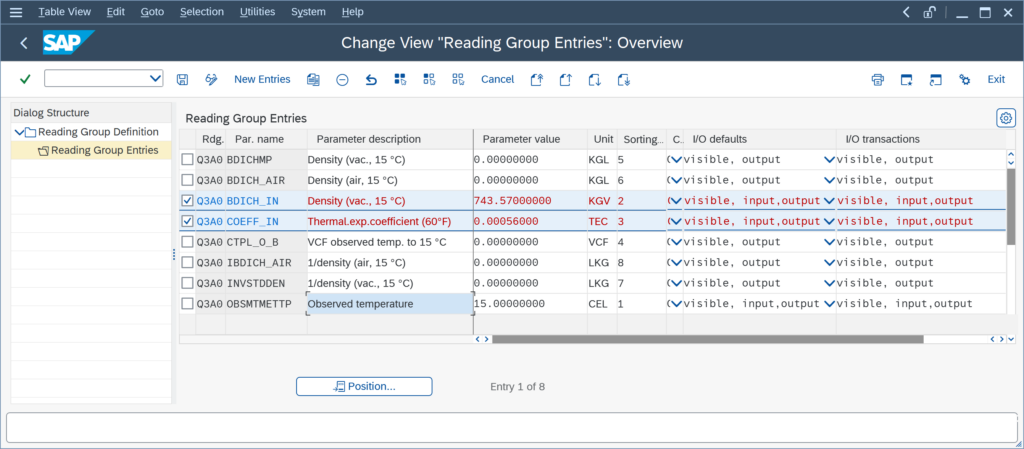
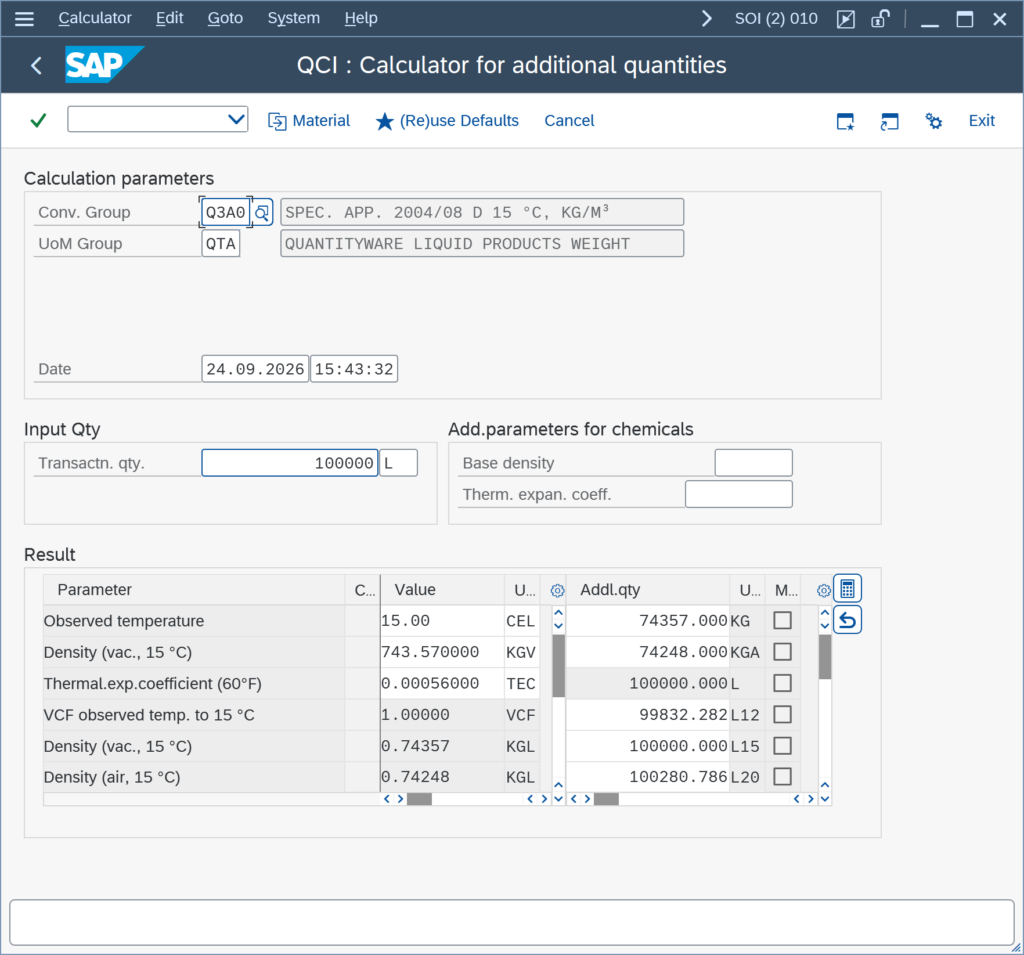
For these MQCI conversion groups the fixed density and thermal expansion coefficient are entered as input parameters with correct UoM – and optionally variable values. Technically, this is achieved via two new input fields, BDICH_IN and COEFF_IN (with UoM BDICHEH_IN and COEFFEH_IN).
Note: In production, one typically fixes these values to the known product values by setting the reading group protection field (visible, output) and defining correct O3DEFAULTS values.
Limitations & additional efforts:
- Due to a rigorous error check in the SAP material master, MQCI conversion groups with product type 3 – Special Applications – require maintenance of the base density and thermal expansion coefficient (without UoM!) in the SAP material master.
These two values are not required for the MQCI calculations, if the new input parameters are defined correctly in the reading group and realistic values are maintained (e.g. via O3DEFAULTS) or entered into the system for any required transaction/business process.
However, if a Z customer specific function module solution – as noted below – is required, maintenance of identical values* (w/o the possibility to maintain the UoM) in the material master as in the reading group (or via transaction O3DEFAULTS) is not only recommended but also required**. - Usage of the SAP BAPI GoodsMovementOil requires that the two QuantityWare Parameters BDICH_IN and COEFF_IN (value and UoM) are passed and mapped correctly via the standard SAP Extensionin technique:
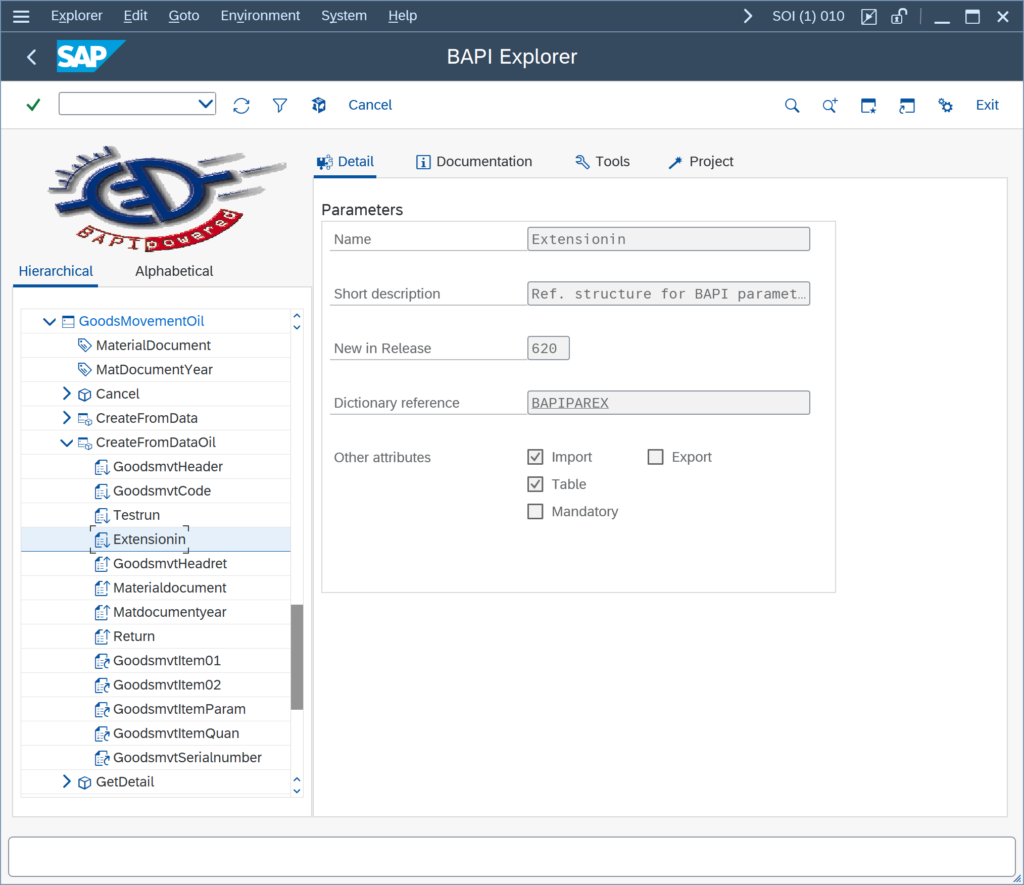
For special applications a customer specific Z ABAP default function may be utilized, such that an Extensionin solution development can be avoided.
- SAP TAS IDOC interfaces do not generally support new QuantityWare input parameters. Thus, customers must extend the relevant IDOC structures as described in note 000107.
For special applications a customer specific Z ABAP default function may be utilized, such that IDOC extensions – as described in note 000107 for other product types – can be avoided. - Some SAP applications (e.g. SAP Tank Management) do read the material master values before calling the central SAP QCI function module and overwrite any other values or may this way create an inconsistent QCI call. Thus, external systems cannot pass their own variable fixed density (and thermal expansion coefficient) to SAP Tank Management.
* The base density (fixed density) in the material master can be entered with 1 decimal accuracy only. Thus, if values with higher accuracy are required, a customer specific Z ABAP default function that reads the material master values may cause inconsistencies and cannot be chosen. With QuantityWare note 000128, two additional default functions are delivered, where one function defaults higher accuracy values form the reading group.
** Technically, ABAP function /QTYW/MQCI_SAP_VAL_PREP_C checks if the two numerical values of the new MQCI parameters are not initial. Otherwise, the material master values are utilized for further processing in customer projects. However, these carry no UoM, which may lead to issues during subsequent calculations (e.g. missing UoM range check or error message during calculations).
Thus, depending on your configuration settings, you may decide to remove or extend function /QTYW/MQCI_SAP_VAL_PREP_C from your MQCI configuration in your Z conversion group, in order to correctly determine the UoM for the two new input parameters via a customer project specific solution.
With QuantityWare note 000128, two additional default functions are delivered, which may be chosen to replace ABAP function /QTYW/MQCI_SAP_VAL_PREP_C, such that IDOC extensions or BAPI Extensionin solutions can be avoided.
Such a task must be carefully decided, executed and tested. Involvement of a QuantityWare Certified Consultant is strongly recommended.
Categories: BCP Configuration FAQs
Back to FAQs