
Does QuantityWare BCP support calculations of gross and net volumes, masses and weights for crude oil?
Yes.
The American Petroleum Institute (API) defines the following quantities in e.g. API MPMS Chapter 12.1.1, which can be mapped to a distinct SAP Dimension ID (DIMID):
- GOV – gross observed volume <-> SAP DIMID GRSVOL, All UoM w/o standard temperature
- GSV – gross standard volume <-> SAP DIMID GRSVOL, All UoM with standard temperature assigned
- NOV – net observed volume <-> SAP DIMID VOLUME, All UoM w/o standard temperature
- NSV – net standard volume <-> SAP DIMID VOLUME, All UoM with standard temperature assigned
- GSW – gross standard weight <-> SAP DIMID GWGHTA, All UoM
- NSW – net standard weight <-> SAP DIMID WGHTA, All UoM
- GSM – gross standard mass <-> SAP DIMID GMASS, All UoM
- NSM – net standard mass <-> SAP DIMID MASS, All UoM
For all these quantities, QuantityWare BCP delivers UoM and new SAP dimensions as part of the configuration template.
Example: Test UoM Group QGP:

Example: Test Calculation with UoM Group QGP:


These UoM are supported for MQCI crude oil conversion groups. The MQCI crude oil conversion groups are configured with one of the four available crude oil gross volume calculation models:
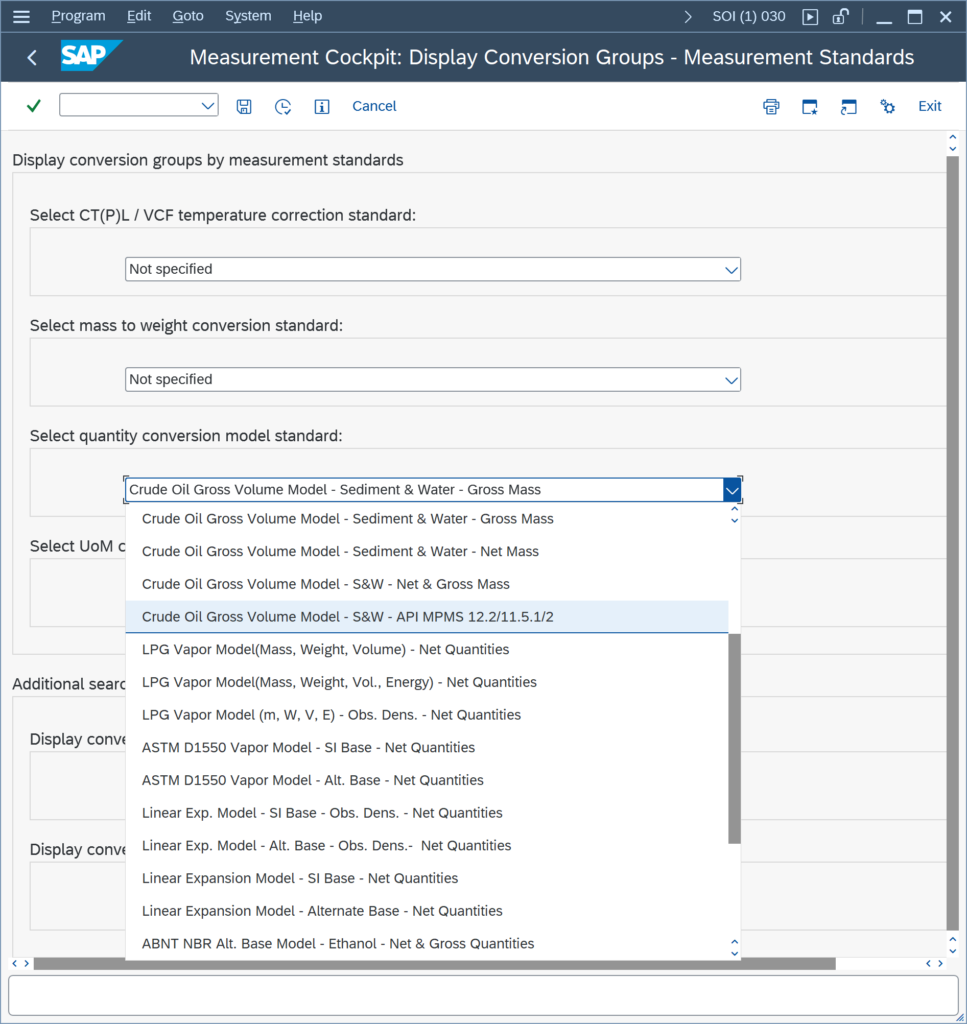
Example:
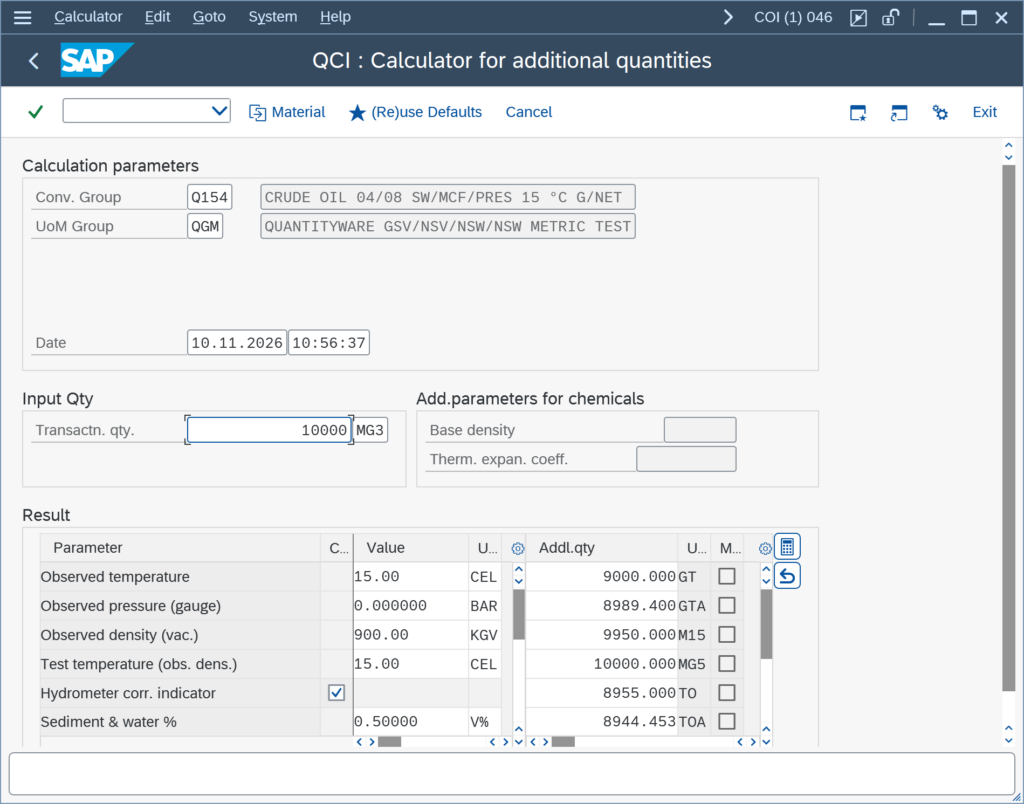
Let’s take a pipeline quality crude oil of 10 000 m³ GSV with a S&W fraction measured to be 0.5 %. We assume that temperatures are all 15 °C for all volumes and densities in this example.
Additionally, we assume that the crude gross density is 900 kg/m³ and the S&W density is 1 200 kg/m³ (water at 15 °C has a density of approx. 1 000 kg/m³ and quartz sediment densities are around 2 600 kg/m³, thus the total S&W density is considerably larger than 900 kg/m³).
The GSM is the GSV times gross density of the crude:
10 000 m³ × 900 kg/m³ = 9 000 000 kg.
The NSV is calculated to be: GSV × ( 1 – %S&W/100)
10 000 m³ × (1 – (0.5/100) = 9 950 m³.
Assuming that the net crude density is also 900 kg/m³, we calculate the NSM to be the NSV times the gross density:
9 950 m³ × 900 kg/m³ = 8 955 000 kg.
The rigorous calculation leads to a different result: The S&W volume is 50 m³. Thus, the mass of the S&W (contained in the 10 000 m³ GSV of crude) is 50 m³ × 1 200 kg/m³ = 60 000 kg.
Then the NSM is the GSM minus the mass of sediment & water:
9 000 000 kg – 60 000 kg = 8 940 000 kg.
Therefore, an error of approx 0.17 % (when compared with the rigorous calculation) has to be accepted for the NSM. As described above, the rigorous calculation requires as input either a second density, the net density of your crude, or the %S&W value on a mass basis, in addition to the gross density and the %S&W value on a volume basis.
Note: For this example, one calculates a sediment and water (S&W) mass fraction of 0.6666… %. As stated above, only if the gross and net crude oil densities are assumend to be identical, the %S&W fractions for volume and mass are the same.
Summary:
Commercial agreements rely on the NSV value for e.g. pricing, as NSM (and NSW) are typically not calculated the rigorous way described here in ERP systems; the net density or mass fraction of sediment and water is usually not passed to the ERP systems in addition to the gross density and volume fraction of sediment and water.
Read also the Sediment & Water FAQ and the Dimension & UoM FAQ.
Watch our Crude Oil Calculation Video on Vimeo, which can also be found on our “What is covered” web page.
Categories: BCP Configuration FAQs | BCS Supported Standards FAQs
Back to FAQs